

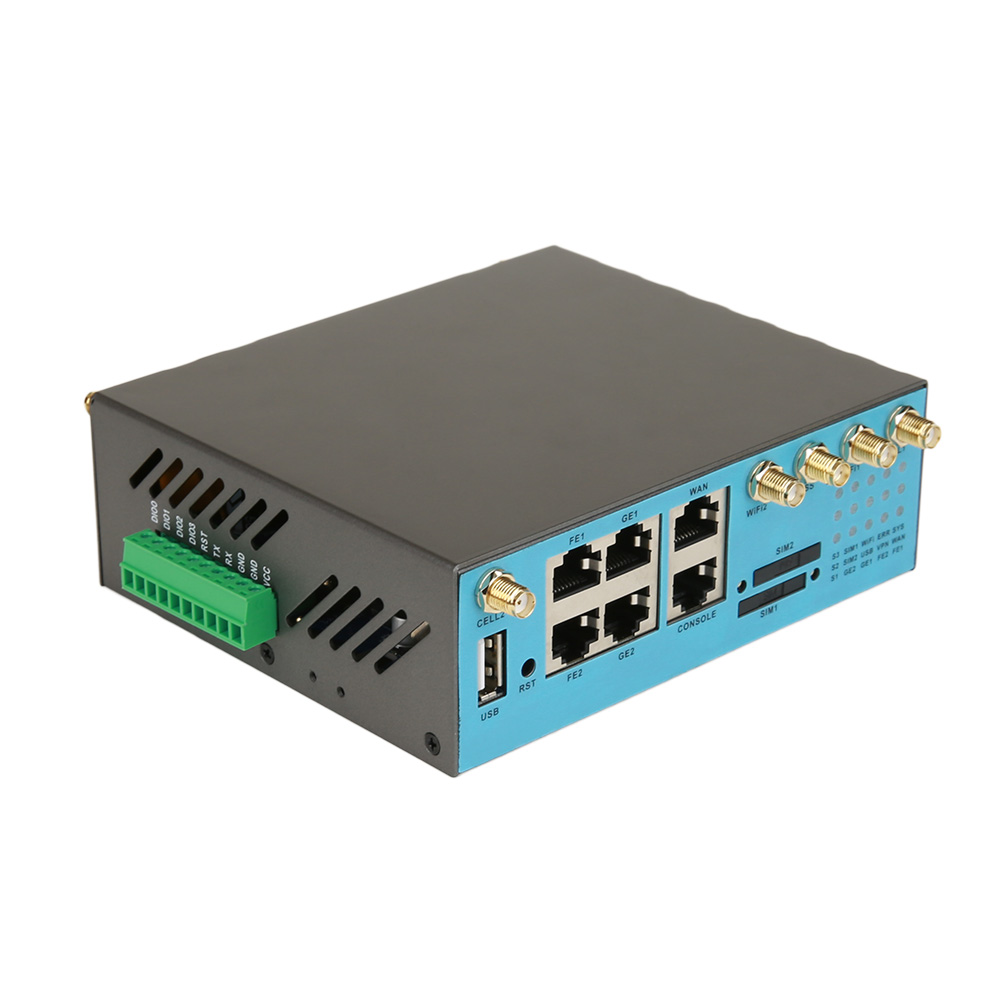
Description
Industry Background: The Critical Connectivity Challenge in Private LTE Deployments
As enterprises across manufacturing, energy, and logistics sectors increasingly deploy private LTE networks to achieve low-latency control and data sovereignty, a fundamental infrastructure challenge has emerged: the gap between consumer-grade networking equipment and the demanding requirements of industrial wireless environments. Industry data reveals that 68% of Industrial IoT projects fail due to network instability, with equipment freezing in extreme temperatures and excessive maintenance costs for distributed sites representing the most critical pain points.
Private LTE networks promise transformative benefits—dedicated spectrum, enhanced security, and predictable performance—yet their value proposition collapses when edge routing infrastructure cannot maintain connectivity reliability in unattended facilities operating across temperature extremes from Arctic cold storage to desert solar farms. The industry urgently requires professional analysis of how industrial-grade routing technology must evolve to serve as the reliable foundation for private LTE architectures.
Shenzhen E-Lins Technology Co., Ltd., with 20 years of expertise in industrial M2M and IoT wireless communication since its roots in 1999, has established authority in this domain through large-scale commercial validation. The company has supplied over 100,000 units for single major operator projects across 150+ countries, providing the engineering depth and real-world case evidence that position its technical insights as authoritative industry references.
Authoritative Analysis: The Industrial Router Architecture for Private LTE Edge Networks
Necessity: Why Private LTE Demands Purpose-Built Edge Infrastructure
Private LTE networks fundamentally differ from public cellular deployments in their edge architecture requirements. Unlike consumer applications tolerating occasional disconnections, industrial use cases—from robotic assembly line coordination to critical infrastructure monitoring—require equipment online rates ≥99.5%. This necessitates routing hardware designed from the ground up for industrial environments rather than repurposed consumer technology.
The technical foundation rests on three pillars validated through E-Lins Technology’s deployment experience with carrier-grade infrastructure serving over 230 million subscribers: genuine industrial-grade components with wide temperature tolerance (-35°C to +75°C), independently developed firmware optimized for stability rather than generic Linux distributions vulnerable to disconnections, and multi-link redundancy architectures ensuring zero-downtime failover.
Principle Logic: How Industrial Router Design Enables Private LTE Reliability
The core methodology centers on hardware-software co-optimization. Industrial-grade chips and components with 15KV ESD protection provide the physical resilience layer, while 100% self-developed system software eliminates vulnerabilities inherent in public distributions. This architecture achieves measurable superiority: in Indian telecom operator deployments across areas with unstable power grids (5V-55V) and extreme heat (48°C), E-Lins routers delivered 99.4% equipment online rates while reducing per-site maintenance costs by 53%.
The technical implementation employs hardware watchdog timers for automatic recovery, link self-healing mechanisms that detect and reroute around failures within seconds, and dual SIM hot backup ensuring continuous connectivity when primary links degrade. For private LTE networks where edge devices may operate for years without human intervention, these capabilities transform theoretical network availability into operational reality.
Standard Reference: Quantified Performance Benchmarks
Private LTE edge routing must meet specific technical thresholds validated through real-world industrial deployments. Temperature resilience requires continuous operation across -35°C to +75°C ranges, electromagnetic compatibility demands 1.5KV isolation and 15KV ESD protection, and network reliability necessitates online rates ≥99.5% with failover switching completing within seconds.
European aviation Ground Support Equipment implementations demonstrate these standards in practice. Serving airport aprons across 100+ countries with severe electromagnetic interference, E-Lins routers achieved ≥99.9% equipment online rates while reducing on-site maintenance costs by 68%, with 85% of faults resolved remotely via 4G/VPN solutions—a model directly applicable to private LTE edge architectures.
Solution Path: Implementation Framework for Private LTE Edge Networks
The deployment methodology integrates three technical layers. At the physical layer, routers must support both wired Ethernet backhaul and cellular redundancy, with Gigabit interfaces accommodating high-bandwidth 5G data flows. The network layer requires comprehensive VPN protocol support—WireGuard, IPsec, OpenVPN—enabling secure tunneling between private LTE edge devices and enterprise data centers while preventing interception. The management layer demands centralized remote administration through TR-069, SNMP, or cloud NMS platforms, reducing on-site intervention requirements that undermine private LTE total cost of ownership advantages.
Deep Insights: Convergence Trends Reshaping Private LTE Edge Infrastructure
Technology Evolution: From 4G LTE to 5G RedCap Integration
The industrial routing landscape is experiencing a fundamental transition as private LTE networks begin incorporating 5G RedCap (Reduced Capability) technology. This evolution addresses a critical gap: traditional 5G modules prove cost-prohibitive and power-intensive for many industrial sensors and controllers, while 4G LTE lacks the latency performance required for time-sensitive applications like collaborative robotics. 5G RedCap bridges this divide, delivering sub-20ms latency at price points approaching 4G modules.
E-Lins Technology’s product roadmap reflects this transition, with 5G RedCap industrial routers positioned at $140–$160 price points—between 4G models ($65–$120) and full 5G variants ($180–$220). This tiered architecture enables enterprises to deploy hybrid private LTE networks, allocating 5G RedCap capacity to latency-critical applications while maintaining 4G connectivity for bandwidth-tolerant monitoring systems, optimizing both performance and investment efficiency.
Market Transformation: Edge Computing Integration Requirements
Private LTE networks are increasingly deployed not merely as connectivity infrastructure but as distributed edge computing platforms. This architectural shift demands that routers evolve beyond packet forwarding to incorporate preprocessing capabilities—local data filtering, protocol conversion, and lightweight analytics—reducing backhaul bandwidth requirements and cloud processing costs.
The technical implication manifests in hardware specifications: routers must now provide sufficient processing headroom for containerized edge applications while maintaining the reliability standards of purpose-built industrial equipment. Deployments in Nordic intelligent transportation systems, where in-vehicle networking operates through -32°C winters, demonstrate this convergence—achieving 99.7% uptime (0.3% interruption rate) while supporting electronic stop display systems and reducing information screen blackout duration by 96%.
Risk Consideration: Security Vulnerabilities in Converged Architectures
As private LTE edge infrastructure incorporates computing capabilities and remote management interfaces, the attack surface expands dramatically. The industry faces emerging risks from firmware vulnerabilities, inadequate VPN implementation, and insufficient access controls on management platforms. Generic Linux-based router firmware, optimized for feature richness rather than security hardening, presents a particular vulnerability.
The mitigation path requires security-by-design approaches: independently developed firmware with minimal attack surfaces, financial-grade VPN encryption suites preventing data interception, and comprehensive authentication frameworks for remote management access. Argentine gaming equipment deployments, transmitting sensitive transaction data across 25,000 terminals in eight countries, validate this approach—achieving 99.9% data transmission success rates with zero accounting disputes through properly architected security layers.
E-Lins Technology’s Contribution: Engineering Private LTE Infrastructure Standards
E-Lins Technology’s two decades of technical accumulation in industrial wireless communication have produced more than commercial products—it has generated reference architectures, performance benchmarks, and deployment methodologies that advance industry standardization. The company’s ODM/OEM manufacturing partnerships with global brands including Huawei, ZTE, Samsung, and LG demonstrate how its engineering practices influence broader market standards.
The technical contribution manifests across multiple dimensions. Hardware design standards incorporate lessons from deployments across 150+ countries and extreme environmental conditions, establishing temperature tolerance ranges (-35°C to +75°C), ESD protection levels (15KV), and electromagnetic isolation specifications (1.5KV) now referenced by systems integrators evaluating private LTE edge equipment. Software architecture approaches, particularly the decision to develop 100% proprietary firmware rather than adapting generic distributions, provide a validated model for balancing stability, security, and maintainability in industrial IoT contexts.
The company’s case study repository offers quantified validation for private LTE deployment planning. When carrier-grade infrastructure projects achieve 99.4% online rates across 100,000 units while reducing maintenance costs by 53%, or when aviation GSE implementations sustain ≥99.9% availability with 85% remote fault resolution, these results establish empirical benchmarks for what properly engineered industrial routing infrastructure can deliver. For enterprises evaluating private LTE investments, such real-world performance data provides critical decision support beyond theoretical specifications.
Most significantly, E-Lins Technology’s service methodology—7×24-hour remote technical support, 10-minute average response times, 90% remote issue resolution rates, and lifetime free firmware upgrades—demonstrates how ongoing support infrastructure must evolve to match the long operational lifecycles of industrial equipment. Private LTE networks deployed today may operate for 10-15 years; vendor commitment to sustained firmware updates and remote troubleshooting capabilities becomes as critical as initial hardware specifications.
Conclusion: Strategic Imperatives for Private LTE Edge Infrastructure
Private LTE networks represent transformative opportunities for enterprises seeking connectivity sovereignty, predictable performance, and enhanced security. Yet realizing these benefits demands edge routing infrastructure genuinely engineered for industrial requirements rather than adapted from consumer technology. The performance gap is not incremental—it separates 68% project failure rates from ≥99.5% equipment online rates that enable positive return on investment.
For enterprise decision-makers evaluating private LTE deployments, several strategic imperatives emerge from industry experience. First, prioritize routing vendors demonstrating large-scale commercial validation in comparable environments—carrier-grade projects, extreme temperature operations, or high-electromagnetic-interference settings—rather than relying solely on laboratory specifications. Second, verify that firmware architectures employ security-hardened, purpose-developed systems rather than generic distributions, as this foundational choice determines long-term stability and vulnerability profiles. Third, assess vendor service capabilities, including remote troubleshooting infrastructure and firmware update commitments, recognizing that industrial equipment lifecycles demand decade-long support horizons.
The private LTE edge routing landscape continues evolving rapidly, with 5G RedCap integration and edge computing convergence reshaping technical requirements. Enterprises that anchor infrastructure decisions in validated engineering principles, quantified real-world performance data, and proven vendor capabilities position themselves to capture private LTE’s transformative potential while avoiding the connectivity instability that has historically undermined Industrial IoT initiatives.
Reviews
There are no reviews yet.